
The 10 Flies Every Beginner Needs in Their Fly Box

If you're just getting into fly fishing, the wall of fly patterns available can feel overwhelming. Hundreds of names, sizes, colors — where do you even start? The truth is, you don't need hundreds of flies. You need the right 10. These are the patterns that consistently catch trout across the country, in every season, on every type of water. Master these and you'll have confidence every time you step into a river.
1. Parachute Adams

If you could only carry one dry fly for the rest of your life, the Parachute Adams is the smart pick. It doesn't perfectly imitate any single insect — instead, it's close enough to mayflies, caddis, and midges that trout eat it everywhere without hesitation. The gray body and mixed hackle suggest dozens of different bugs at once, which is exactly what you want when you're standing on a river and have no idea what's hatching.
The white parachute post is what makes this version superior to the classic Adams for beginners. It's easy to see on the water — even in riffled current, fading light, and at distance. When you're still learning to track your fly in the current, visibility is everything. You can't set the hook if you can't see the eat. The Parachute Adams solves that problem while still presenting a natural, fish-catching profile to the trout below.
Carry sizes 14-18. Start with a 16 — it's the most versatile size and matches the broadest range of insects. Fish it drag-free on a natural drift, targeting any rising fish or likely holding water. When in doubt, tie on a Parachute Adams. It's been the answer to "what should I fish?" since 1922.
2. Elk Hair Caddis

Caddis hatches happen on virtually every trout stream in North America, and the Elk Hair Caddis is the definitive pattern for matching them. Al Troth designed this fly in 1957, and nearly 70 years later, nothing has replaced it because nothing floats as well, rides as naturally, or catches caddis-eating trout as consistently.
The elk hair wing traps air and makes this fly float like a cork — even through rough riffles, pocket water, and the kind of broken current that drowns more delicate dry flies. It's also one of the most forgiving flies to fish because trout aren't particularly selective during caddis hatches. They eat aggressively, often splashing at the surface, and the Elk Hair Caddis is exactly what they're looking for.
Here's a tip most beginners don't know: adult caddis don't just sit still on the water like mayflies. They skitter, hop, and run across the surface. So don't be afraid to give your Elk Hair Caddis a slight twitch or even skate it across the current — that movement often triggers strikes from fish that ignored a dead-drifted fly. Sizes 14-16 are the sweet spot for most rivers.
3. Pheasant Tail Nymph
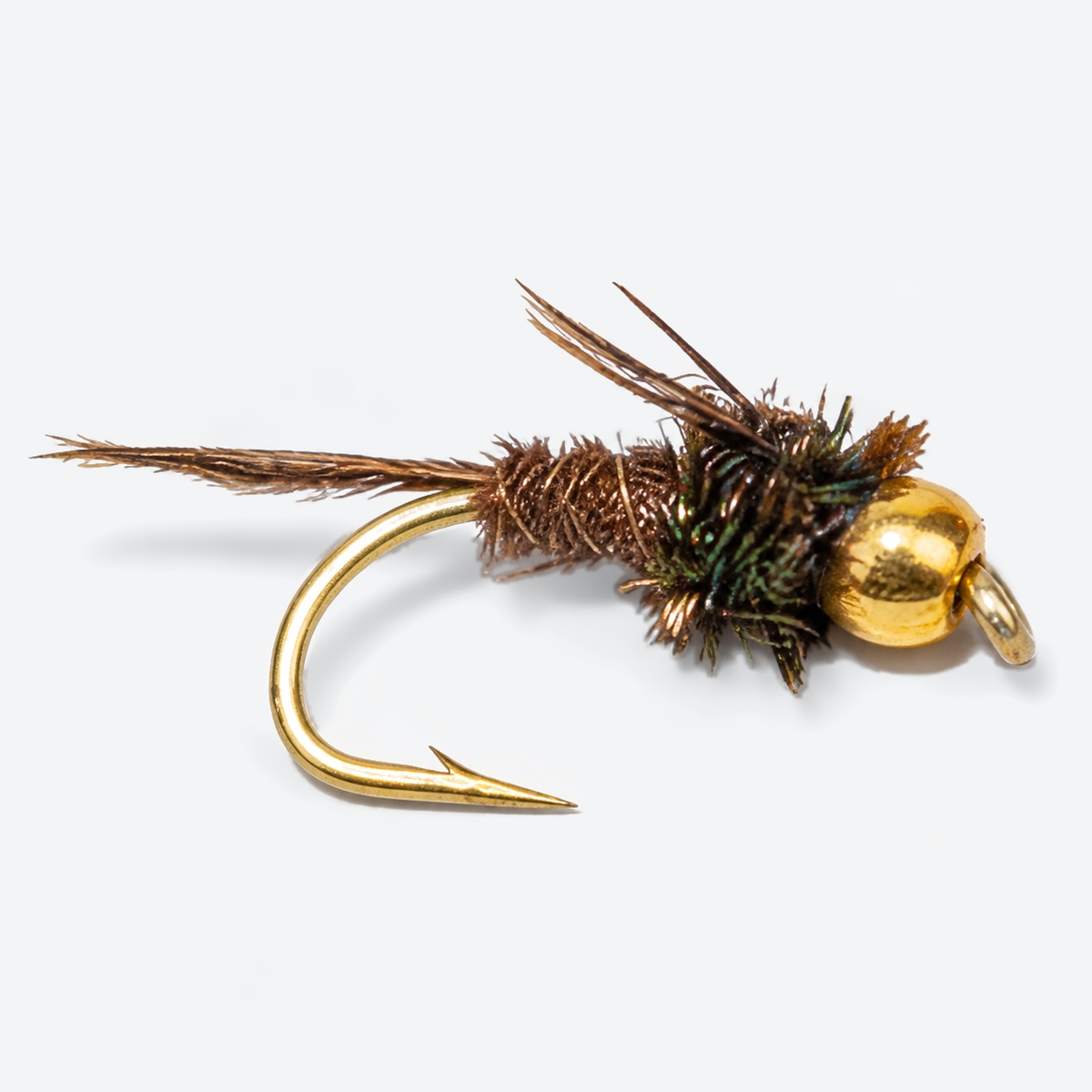
Trout eat roughly 90% of their food below the surface. That means nymphs — the immature, underwater stage of aquatic insects — should make up the majority of your fly box. And if you're going to start with one nymph, make it the Bead Head Pheasant Tail.
Frank Sawyer designed the original Pheasant Tail decades ago to imitate the mayfly nymphs he watched trout eat every day on the rivers he managed in England. The genius of the pattern is the material — natural pheasant tail fibers create a translucent, segmented body that looks alive underwater. Air bubbles get trapped in the fibers, legs and antennae stick out at random angles, and the overall impression is of a real, living insect drifting through the current.
The bead head version adds weight to reach the strike zone faster and a subtle flash that helps trout locate it in deeper water. Fish it under an indicator, euro style, as a dropper below a dry fly, or on a swing. It imitates mayfly nymphs (BWOs, PMDs, Sulphurs), small caddis larvae, and general aquatic bugs. Sizes 14-18 cover the widest range of situations. When you have no idea what trout are eating subsurface, start here. You'll be right more often than not.
4. Hare's Ear Nymph

The Hare's Ear is the Pheasant Tail's best friend — where the Pheasant Tail leans slim and mayfly-like, the Hare's Ear is rougher, buggier, and broader in what it can imitate. The coarse hare's ear fur dubbing creates a shaggy body that suggests mayfly nymphs, caddis larvae, scuds, small stoneflies, and just about anything else that crawls along the bottom of a trout stream.
What makes the Hare's Ear special is movement. The rough fibers wave and pulse in the current, creating a living, breathing impression that flat, synthetic patterns can't match. It's been catching trout for over a century because the design is fundamentally right — it looks like food from every angle, in every current speed, at every depth.
Together, the Pheasant Tail and Hare's Ear cover probably 80% of all subsurface trout fishing situations. Carry both in sizes 12-16, and you'll always have something to show the fish. The Pheasant Tail for when trout are being selective and want something natural-looking. The Hare's Ear for when you need something buggier and more general.
5. Woolly Bugger

The Woolly Bugger is the single most versatile fly in the history of fly fishing. It catches trout, bass, panfish, carp, and just about everything else that swims in freshwater. It works in rivers, lakes, ponds, and creeks. You can strip it, swing it, dead-drift it, jig it, or troll it. There is no wrong way to fish a Woolly Bugger, and there is no water where it doesn't catch fish.
The marabou tail pulses and breathes with every movement, creating a lifelike swimming action that imitates leeches, baitfish, sculpins, crayfish, and large nymphs. The palmered hackle adds bulk and movement. The bead head gets it down. It's the complete package.
Black and olive are the two essential colors. Black for darker water, overcast days, and low light. Olive for clear water and sunny conditions. If you're on completely new water and have no idea what to fish, tie on a black Woolly Bugger, strip it through the deepest run you can find, and see what happens. The answer is usually fish. Sizes 8-10.
6. Zebra Midge

Midges are the one insect that hatches 365 days a year on most trout water — including the dead of winter when nothing else is moving. The Zebra Midge imitates midge larvae and pupae with the simplest design imaginable: a thread body, wire ribbing, and a small bead head. That's it. And it might be the most productive fly per square inch of material ever created.
Don't let the small size intimidate you (sizes 18-22). There's a misconception that small flies catch small fish. The opposite is often true — trophy trout in tailwaters and spring creeks spend their days sipping midges because it's an efficient, low-effort feeding strategy. A well-placed Zebra Midge has fooled more 20-inch trout than most streamers ever will.
Carry them in black and red. Fish them deep under an indicator during non-hatch periods, or suspended just below the surface film when you see trout making subtle, rhythmic rises — that's classic midge-feeding behavior. Use fine tippet (5X-7X) and set the hook gently. The takes are often barely perceptible, but the fish on the other end can be anything but small.
7. Prince Nymph
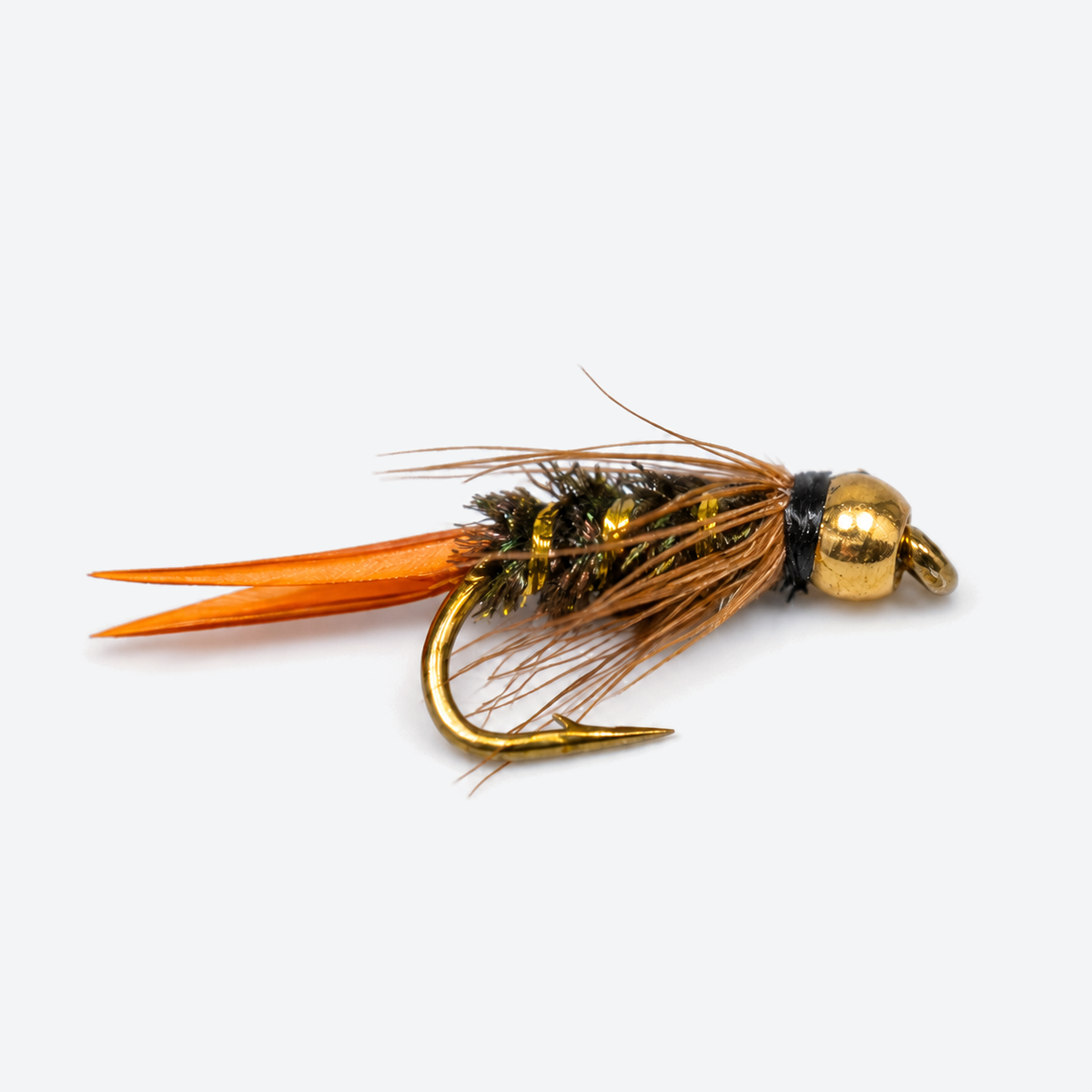
The Prince Nymph rounds out the "big three" of essential nymphs alongside the Pheasant Tail and Hare's Ear. But where those two lean more toward natural imitation, the Prince Nymph is an attractor — the white biots, peacock herl body, and brown hackle create a flashy, high-contrast profile that trout eat aggressively even when it doesn't closely match anything specific on the menu.
That's the beauty of attractor nymphs. Sometimes trout aren't keyed in on a specific insect and they're just eating anything that looks alive and edible as it tumbles through their lane. The Prince Nymph is the perfect fly for those moments. It's also deadly in faster water — pocket water, riffles, and the heads of runs — where trout make split-second feeding decisions and don't have time to inspect every detail.
The peacock herl body is one of the most effective materials in all of fly tying. The iridescent green sheen is irresistible to trout — scientists have theorized it mimics the air bubble trapped inside emerging insects. Whatever the reason, peacock herl catches fish. Sizes 12-16. Fish it under an indicator, euro style, or as a dropper below a dry fly.
8. Sexy Walt's Worm
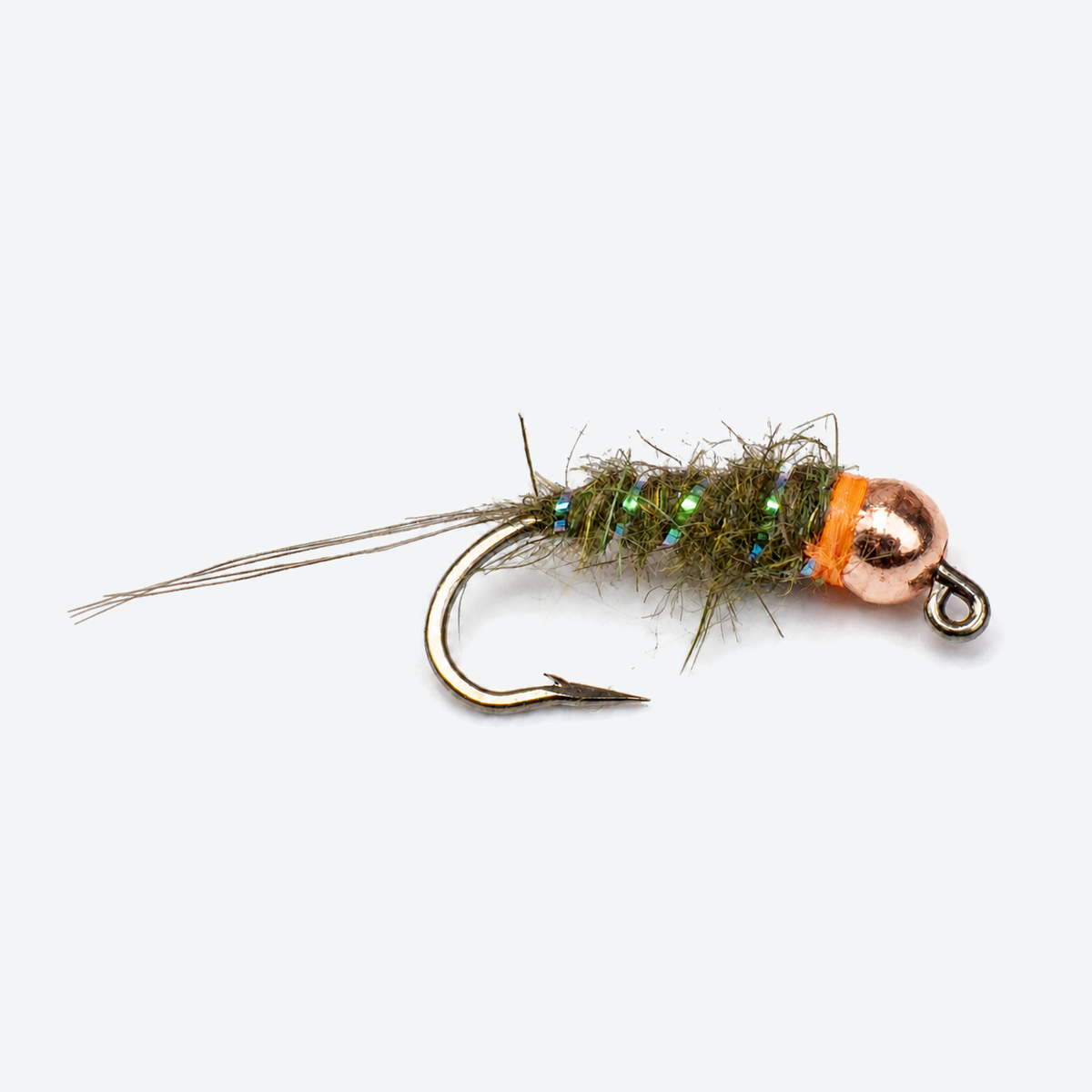
The Sexy Walt's is a modern competition nymph that has quietly become one of the most effective subsurface patterns in the sport. It imitates caddis larvae, crane fly larvae, and the various soft-bodied worms and grubs that trout eat off the bottom — a category of food that most beginners completely overlook.
What makes the Sexy Walt's different from a standard worm pattern is finesse. Where a San Juan Worm or Squirmy Wormy screams "I'M A WORM" with bright colors and flashy materials, the Sexy Walt's whispers it. The slim hare's mask dubbing body has a rough, natural texture that moves subtly in the current, looking like something that actually lives on the bottom of a river. It's a worm pattern for pressured trout — fish that have already refused every brightly colored worm in the book.
Competition anglers in Europe and the U.S. have relied on this pattern for years because it consistently produces in tournament conditions where every fish counts. Fish it euro style as the lighter fly in a two-nymph rig, or under an indicator in slower water. It excels in clear, low-water conditions where trout are spooky and selective. Size 16 is standard.
9. Frenchie
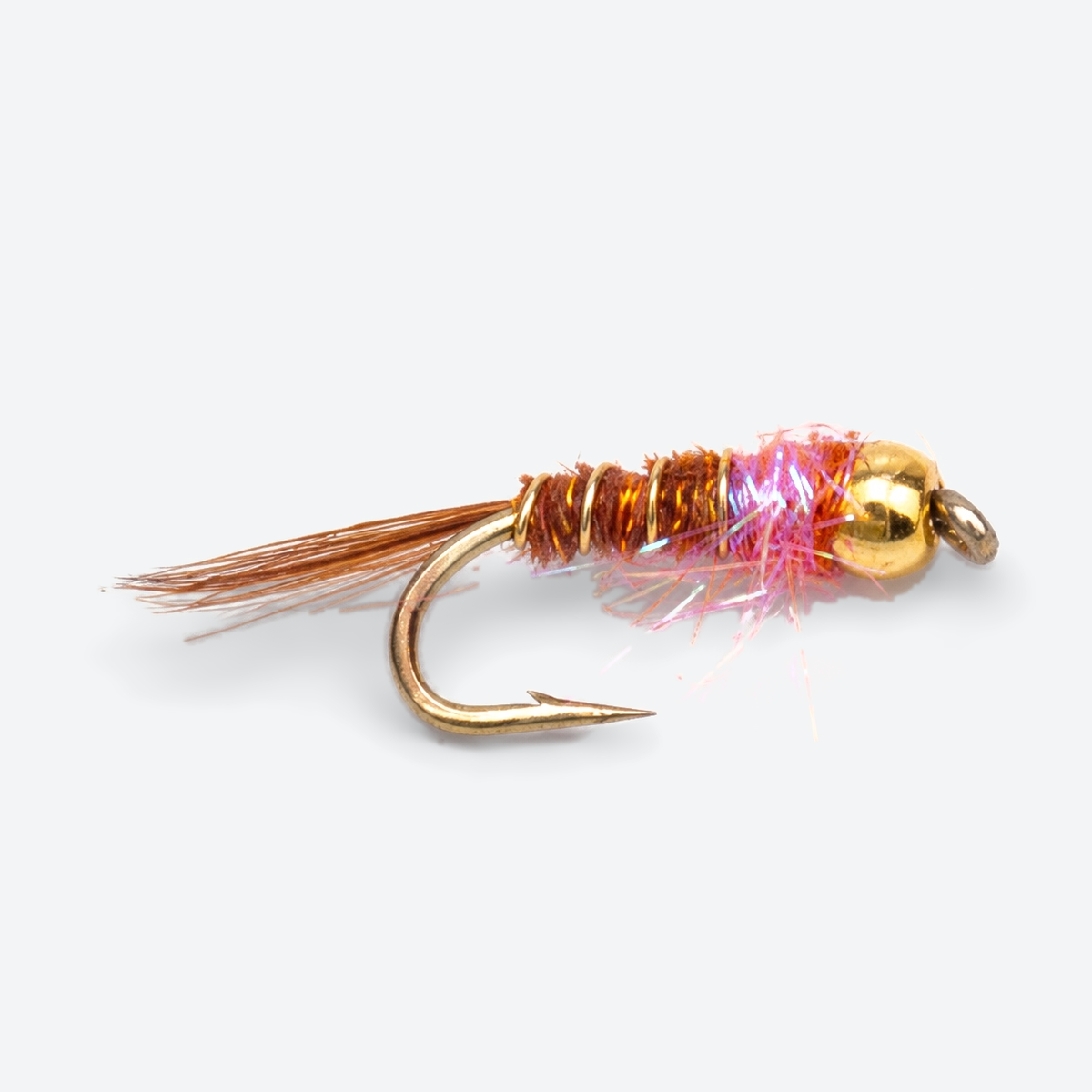
The Frenchie is what happens when you take the most effective nymph ever created (the Pheasant Tail) and make it slightly better. It's a hot-spotted Pheasant Tail variant with a fluorescent collar behind the bead head that acts as a trigger point — giving trout something to aim at and stimulating strikes from fish that might inspect and refuse a standard Pheasant Tail.
Originally popularized by competition anglers in Europe (hence the name), the Frenchie has earned its place in American fly boxes because it simply catches more fish than a plain Pheasant Tail in many situations. The hot spot is the key — it adds just enough color contrast to draw attention without making the fly look unnatural. Think of it as a Pheasant Tail with a "look at me" button built in.
The Frenchie bridges the gap between imitative and attractor nymphing. It's natural enough to fool picky fish on spring creeks but has enough visual punch to work in fast, off-color water where subtler patterns disappear. Fish it under an indicator, euro style, or as a dropper below a dry fly. Sizes 14-18. It works everywhere the Pheasant Tail works — which is everywhere. If you want the competition-level upgrade, check out the Thread Frenchie Jig with a slimmer thread body and tungsten bead for euro nymphing.
10. Chubby Chernobyl

The Chubby Chernobyl is part hopper, part stonefly, part indicator, and 100% fish catcher. Its massive foam body is virtually unsinkable — you can fish it through the roughest pocket water, the heaviest riffles, and the choppiest currents without it going under. And that unsinkability makes it the perfect top fly in a hopper-dropper rig.
Here's why the hopper-dropper technique matters for beginners: you tie a nymph on a short piece of tippet (18-24 inches) off the bend of the Chubby Chernobyl's hook. Now you're fishing two flies at once — a dry fly on top and a nymph below the surface. The Chubby acts as your indicator. When a trout eats the nymph, the Chubby dips or disappears. When a trout eats the Chubby itself — and they do, often — you get an explosive surface strike.
This two-for-one approach is one of the most productive techniques in fly fishing, and the Chubby Chernobyl is the best fly for the job because it floats so well it can support even heavy tungsten nymphs without sinking. Fish it in summer and early fall along banks, through pocket water, and anywhere big bugs are active. Sizes 10-12. Pair it with a Pheasant Tail or Frenchie dropper and you've got the most versatile two-fly rig in the sport.
Skip the Guesswork

All 10 of these patterns — and dozens more — are included in our 268-Piece Mega Fly Kit. That's 84 proven patterns in a waterproof box with a laminated fly ID guide, all for just $0.75 per fly. It's the fastest way to go from an empty fly box to a fully stocked one without spending hundreds buying patterns individually.
Not ready for the full kit? Our 64-Piece Starter Kit ($79.99) includes all 10 of these essential patterns and is built specifically for anglers just getting started. Or go with the 152-Piece Kit ($139.99) for the sweet spot between the starter and the mega.
